

Playing to Learn and Learning to Play
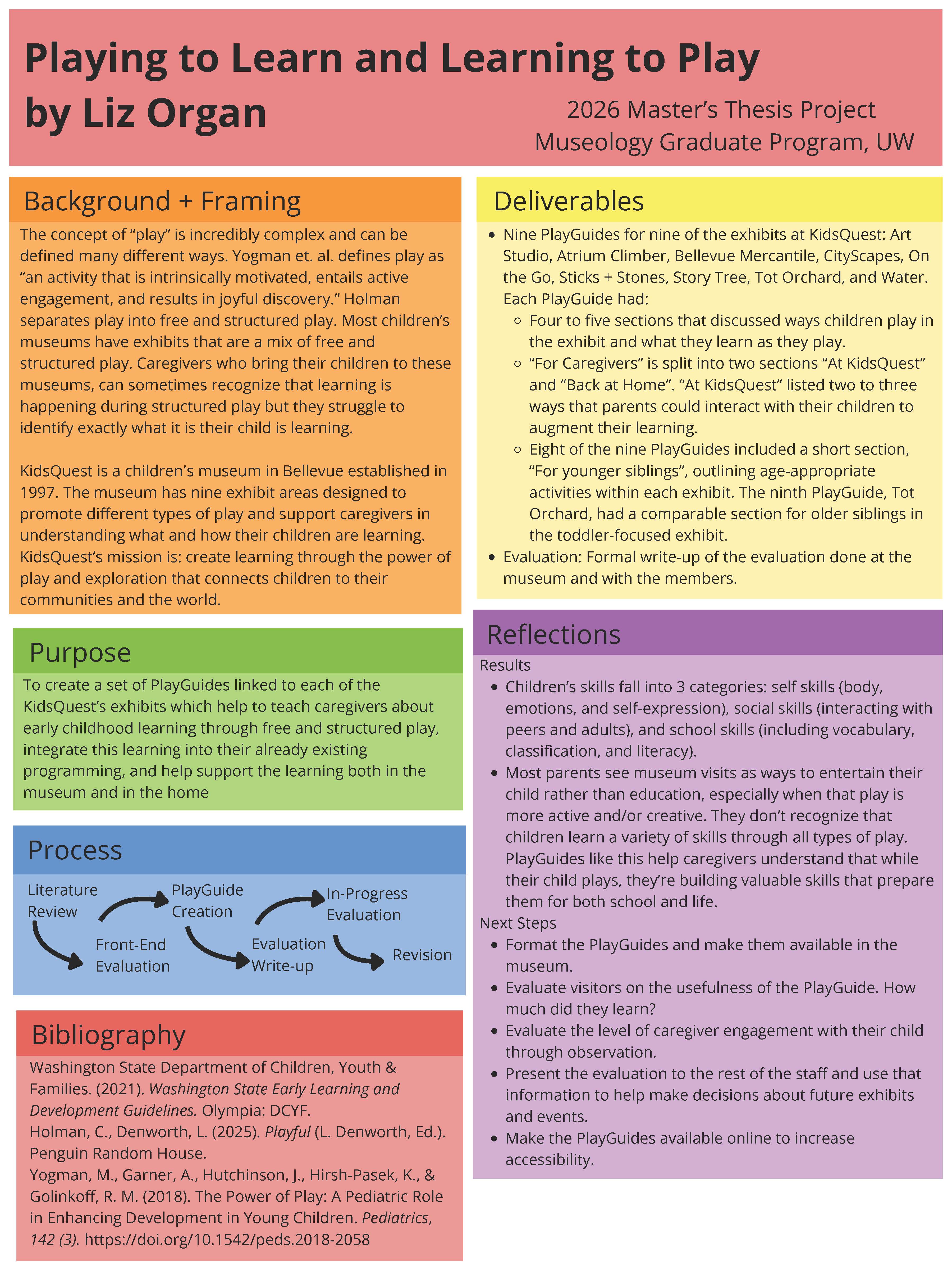
Full description
Authors:
- Liz Organ, Master of Arts in Museology
- Chair: Meena Selvakumar
- AJ Curde
- Kim Aziz
Contact the author
Abstract:
Children learn more when the adults in their lives are engaged. Children’s museums offer a unique setting for caregivers to be involved in their child’s learning, particularly for children not yet in school. However, many caregivers use children’s museums to entertain their children, especially during bad weather or holidays from school. Even those that recognize play has educational value can rarely articulate what, or how, their child is actually learning. The purpose of this project is to create a guide that teaches caregivers about early childhood learning through free and structured play to help support learning, both in the museum and in the home. Each guide consists of three parts: main, secondary, and “For Caregivers.” The main section has four to five bullet points detailing ways children might play in the exhibit, and what they might learn as they do so. The second section outlines age-appropriate activities for older or younger siblings so that caregivers can include children of all ages in the learning process. The final part is “For Caregivers;” a section that lists ways caregivers can directly interact with their children to augment their learning both in the museum and at home. These guides aim to give caregivers deeper insight into what their children are learning so they can offer meaningful support.
Poster:
Download a copy of the project poster
Project Deliverable:
Playing to Learn and Learning to Play
Video Presentation
Comments
to view and add comments.
Annotations
No one has annotated a text with this resource yet.
- typeImage
- created on
- file formatjpg
- file size1 MB
- creatorOrgan
- publisherMuseumsForward
- publisher placeSeattle, WA
- rightsCreative Commons Attribution No Derivatives