The Objectionable Li Zhi: The Objectionable Li Zhi

The Objectionable Li Zhi
  • Show the following:

    Annotations
    Resources
  • Adjust appearance:

    Font
    Font style
    Color Scheme
    Light
    Dark
    Annotation contrast
    Low
    High
    Margins
  • Search within:
    • Notifications
    • Privacy
  • Project HomeThe Objectionable Li Zhi
  • Projects
  • Learn more about Manifold

Notes

table of contents
  1. Title Page
  2. Copyright
  3. Contents
  4. Acknowledgments
  5. Introduction
  6. Part I. Authenticity and Filiality
    1. 1. The Paradoxes of Genuineness: Problematic Self-Revelation in Li Zhi’s Autobiographical Writings
    2. 2. Li Zhi’s Strategic Self-Fashioning: Sketch of a Filial Self
  7. Part II. Friends and Teachers
    1. 3. The Perils of Friendship: Li Zhi’s Predicament
    2. 4. A Public of Letters: The Correspondence of Li Zhi and Geng Dingxiang
    3. 5. Affiliation and Differentiation: Li Zhi as Teacher and Student
  8. Part III. Manipulations of Gender
    1. 6. Image Trouble, Gender Trouble: Was Li Zhi An Enlightened Man?
    2. 7. Native Seeds of Change: Women, Writing, and Rereading Tradition
  9. Part IV. Textual Communities
    1. 8. An Avatar of the Extraordinary: Li Zhi as a Shishang Writer and Thinker in the Late-Ming Publishing World
    2. 9. Performing Authenticity: Li Zhi, Buddhism, and the Rise of Textual Spirituality in Early Modern China
  10. Part V. Afterlives
    1. 10. Performing Li Zhi: Li Zhuowu and the Fiction Commentaries of a Fictional Commentator
    2. 11. The Question of Life and Death: Li Zhi and Ming-Qing Intellectual History
  11. Glossary
  12. Bibliography
  13. Contributors
  14. Index

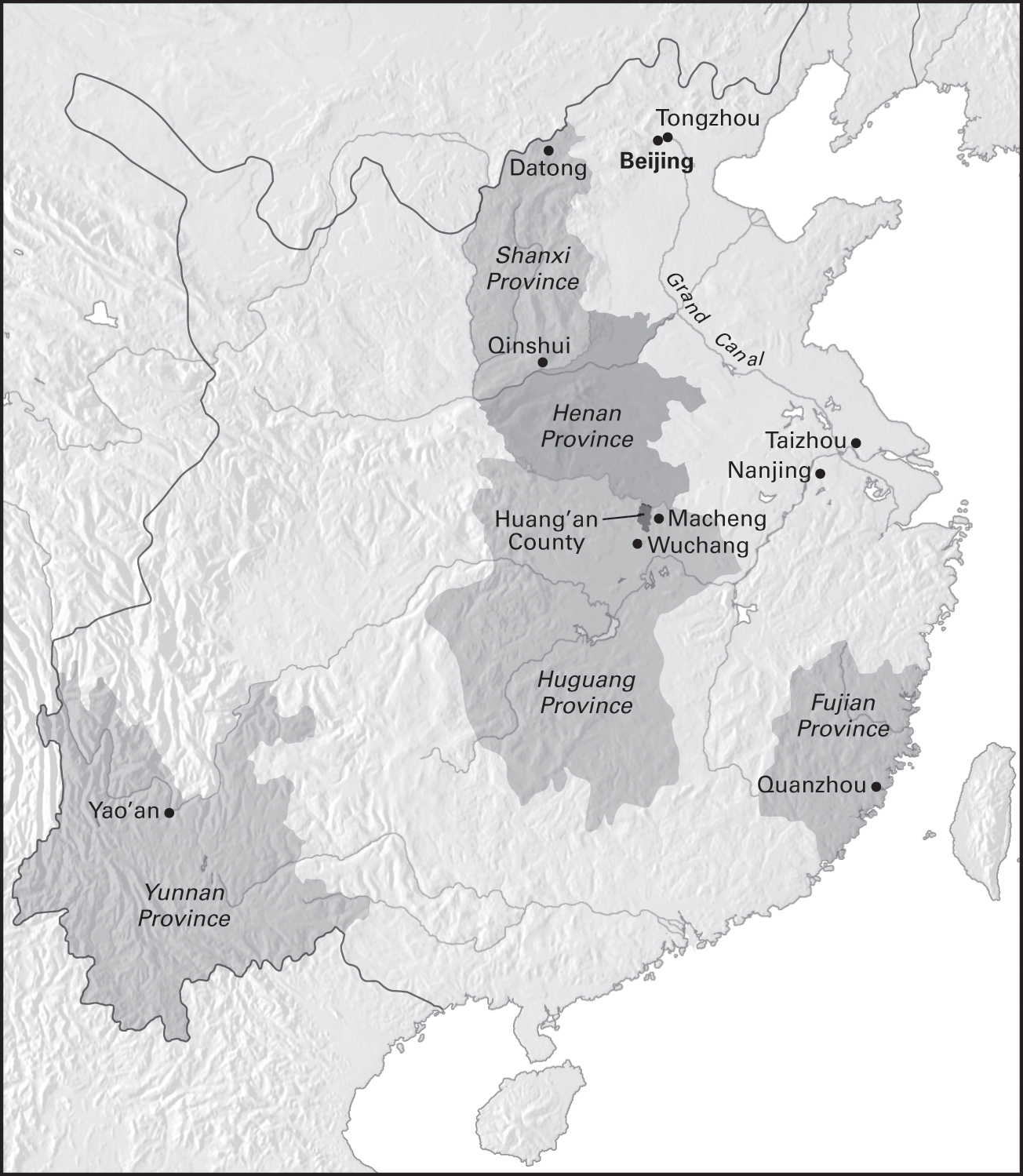
Highlighted on the map are Yunnan Province and the city of Yao'an in the southwest; Shanxi, Henan, and Huguang Provinces in the middle of the country, along with the cities of Datong, Qinshui, Macheng, and Wuchang, and Huang'an County; Beijing and Tongzhou at the northern end of the Grand Canal, and Nanjing and Taizhou near its southern end; and Fujian Province and the city of Quanzhou in the southeast along the coast.

Late-Ming China, highlighting cities and regions significant to Li Zhi. Reprinted from A Book to Burn and A Book to Keep (Hidden).

Annotate

Next Chapter
Introduction
PreviousNext
All rights reserved
Powered by Manifold Scholarship. Learn more at
Opens in new tab or windowmanifoldapp.org